Translate

Showing posts with label American History. Show all posts

Wednesday, April 13, 2022

Ellis Island Family History


On April 17th, 1907, 11,747 names were recorded as passing through Ellis Island.  It was the busiest day of Immigration in U.S. history.  While in operation from 1892 to 1954, roughly 12 million immigrants. passed through Ellis Island.  Among these were my Grandmother and my mother (age 17 and 10 weeks). My Grandparents met when my grandfather was stationed in England during WW2 and married on May 8, 1945.  Grandma and my mother arrived in America, for the first time, in June of 1946.   Grandma once shared with me her instances of culture shock, the biggest was when she was brought to a supermarket for the first time.  Keep in mind that food rationing started in January of 1940 in England and continued even after the war (https://en.wikipedia.org/wiki/Rationing_in_the_United_Kingdom).  Grandma said her first instinct was to fill the cart because she had  a "get it before its gone" mentality and had trouble believing that the store would just restock their shelves    

April 17th is NATIONAL ELLIS ISLAND FAMILY HISTORY DAY and to encourage people to  get to know their family history.   Statue of Liberty— Ellis Island Foundation, Inc offers a searchable passenger list, that includes the passenger record, the ship manifest, and ship information. 

You can also explore your ancestry at the library!  When you're logged into one of our computers, just check out the Virtual Library and click on the link for ancestrylibrary.com in our eResources.


Encountering Ellis Island: How European Immigrants Entered America by Bayor, Ronald H.

America is famously known as a nation of immigrants. Millions of Europeans journeyed to the United States in the peak years of 1892-1924, and Ellis Island, New York, is where the great majority landed. Ellis Island opened in 1892 with the goal of placing immigration under the control of the federal government and systematizing the entry process. Encountering Ellis Island introduces readers to the ways in which the principal nineteenth- and early twentieth-century American portal for Europeans worked in practice, with some comparison to Angel Island, the main entry point for Asian immigrants.


When more than twenty million immigrants arrived in the United States between 1880 and 1920, the government attempted to classify them according to prevailing ideas about race and nationality. But this proved hard to do. Ideas about racial or national difference were slippery, contested, and yet consequential--were "Hebrews" a "race," a "religion," or a "people"? As Joel Perlmann shows, a self-appointed pair of officials created the government's 1897 List of Races and Peoples, which shaped exclusionary immigration laws, the wording of the U.S. Census, and federal studies that informed social policy. Its categories served to maintain old divisions and establish new ones. Across the five decades ending in the 1920s, American immigration policy built increasingly upon the belief that some groups of immigrants were desirable, others not. Perlmann traces how the debates over this policy institutionalized race distinctions--between whites and nonwhites, but also among whites--in immigration laws that lasted four decades. Despite a gradual shift among social scientists from "race" to "ethnic group" after the 1920s, the diffusion of this key concept among government officials and the public remained limited until the end of the 1960s. Taking up dramatic changes to racial and ethnic classification since then, America Classifies the Immigrants concentrates on three crucial reforms to the American Census: the introduction of Hispanic origin and ancestry (1980), the recognition of mixed racial origins (2000), and a rethinking of the connections between race and ethnic group (proposed for 2020).-- Provided by publisher.


"A sweeping history of the legislative battle to reform American immigration laws that set the stage for the immigration debates roiling America today. The idea of the United States as a nation of immigrants is today so pervasive, and seems so foundational, that it can be hard to believe Americans ever thought otherwise. But a 1924 law passed by Congress instituted a system of ethnic quotas so stringent that it choked off large-scale immigration for decades, sharply curtailing immigration from southern and eastern Europe and outright banning people from nearly all of Asia. In a compelling narrative with a fascinating cast of characters, Jia Lynn Yang recounts how a small number of lawmakers, activists, and presidents worked relentlessly for the next forty years to abolish the 1924 law and its quotas. Their efforts established the new mythology of the United States as "a nation of immigrants" that is so familiar to all of us now. Through a world war, a global refugee crisis, and a McCarthyist fever that swept the country, these Americans never stopped trying to restore the United States to a country that lived up to its vision as a home for "the huddled masses" from Emma Lazarus's famous poem. When the 1965 Immigration and Nationality Act, one of the most transformative laws in the country's history, ended the country's system of racial preferences among immigrants, it opened the door to Asian, Latin American, African, and Middle Eastern migration at levels never seen before-paving the way for America's modern immigration trends in ways those who debated it could hardly have imagined"--. Provided by publisher.

Life in America: Comparing Immigrant Experiences by Baker, Brynn

Immigrant groups were not treated equally when they arrived in America. Some were loved and welcomed. Others were hated and cast aside. Compare and contrast immigrant experiences and how those experiences changed the United States. Meets Common Core standards for comparing accounts of an event


Award-winning author Kathleen Krull takes an in-depth historical look at immigration in America--with remarkable stories of some of the immigrants who helped build this country. With its rich historical text, fascinating sidebars about many immigrants throughout time, an extensive source list and timeline, as well as captivating photos, American Immigration will become a go-to resource for every child, teacher, and librarian discussing the complex history of immigration. America is a nation of immigrants. People have come to the United States from around the world seeking a better life and more opportunities, and our country would not be what it is today without their contributions. From writers like Chimamanda Ngozi Adichie, to scientists like Albert Einstein, to innovators like Elon Musk, this book honors the immigrants who have changed the way we think, eat, and live. Their stories serve as powerful reminders of the progress we've made, and the work that is still left to be done


"Stories of remarkable American immigrants are brought to life in short, lyrical biographies written by Sara Nović and charming full-color illustrations by artist Alison Kolesar. Some of the names you'll find here are familiar: Founding father Alexander Hamilton was born and raised on the tiny Caribbean island of Nevis before coming to New York to pursue his education, and Yoko Ono's parents disapproved when she fell in with the bohemian art scene after the family moved to the United States from post-war Japan. Some less so: when Ronald Reagan was shot in 1981, three of the doctors who saved his life were immigrants. Many iconically 'American' products wouldn't be here without their immigrant inventors: Levi jeans, Chevrolet, Nathan's Famous hotdogs, Chef Boyardee, Carvel ice cream. At a time when so much of public debate is focused on who belongs in America, and who doesn't, this book offers an opportunity to celebrate the diverse paths and contributions of so many of our friends and neighbors. America is Immigrants features athletes and war heroes, Supreme Court justices and pop stars, fashion designers and Civil Rights leaders, including: Madeleine Albright; Isabel Allende; Desi Arnaz; Isaac Asimov; George Balanchine; Sergey Brin; Gisele Bundchen; Willem de Kooning; Marlene Dietrich; Albert Einstein; Alfred Hitchcock; Arianna Huffington; Enrique Iglesias; Iman; Hedy Lamarr; Yo-Yo Ma; Pedro Martinez; Joni Mitchell; Sidney Poitier; Wolfgang Puck; Rihanna; Knute Rockne; Nikola Tesla; The von Trapps; Elie Wiesel; Anna Wintour"-- Provided by publisher.

Taste Makers: Seven Immigrant Women who Revolutionized Food in America by Sen, Mayukh

"America's modern culinary history told through the lives of seven pathbreaking chefs and food writers. Who's really behind America's appetite for foods from around the globe? This group biography from an electric new voice in food writing honors seven extraordinary women, all immigrants, who left an indelible mark on the way Americans eat today. Taste Makers stretches from World War II to the present, with absorbing and deeply researched portraits of figures including Mexican-born Elena Zelayeta, a blind chef; Marcella Hazan, the deity of Italian cuisine; and Norma Shirley, a champion of Jamaican dishes. In imaginative, lively prose, Mayukh Sen-a queer, brown child of immigrants-reconstructs the lives of these women in vivid and empathetic detail, daring to ask why some were famous in their own time, but not in ours, and why others shine brightly even today. Weaving together histories of food, immigration, and gender, Taste Makers will challenge the way readers look at what's on their plate-and the women whose labor, overlooked for so long, makes those meals possible"--. Provided by publisher.


"This historical review of the US treatment of immigrants and minority groups documents the suspicion and persecution that often met newcomers and those perceived to be different"-- Provided by publisher.


"A rollercoaster ride of a memoir, by turns hilarious and heartbreaking, by the journalist, playwright, and political activist Wajahat Ali. "Go back to where you came from, you terrorist!" This is just one of the many warm, lovely, and helpful tips that Wajahat Ali and other children of immigrants receive on a daily basis. Go back where exactly? His hometown in the San Francisco Bay Area, where he can't afford rent? Awkward, left-handed, suffering from OCD, and wearing Husky pants, Ali grew up on the margins of the American mainstream, devoid of Brown superheroes, where people like him were portrayed as goofy sidekicks, shop owners with funny accents, sweaty terrorists, or aspiring sweaty terrorists. Driven by his desire to expand the American narrative to include protagonists who look like him, he became a writer, and in the aftermath of the 9/11 terror attacks, an accidental activist and ambassador of all things Muslim-y. He uses his pen with turmeric-stained fingernails to fill in missing narratives, challenge the powerful, and booby trap racist stereotypes. In his bold, hopeful and hilarious memoir, Ali offers indispensable lessons and strategies to help cultivate a more compassionate America"--. Provided by publisher.


Wednesday, January 12, 2022

Prohibition


A proper study of American History would not be complete without alcohol; lots and lots of alcohol.  From the very beginning alcohol has had a profound influence on America: “The Pilgrims landed the Mayflower at Cape Cod, Massachusetts, on a cold November day in 1620 because they were running out of beer.”― Susan Cheever, Drinking in America: Our Secret History

In colonial times, Britain attempted to exert their parental rights by putting a ban on alcohol in Georgia due to an overabundance of rum and brandy consumption.  In turn, Georgia farmers took this as an opportunity not only to run illegal stills but to run to South Carolina for booze.  https://prohibition.themobmuseum.org/the-history/the-road-to-prohibition/why-prohibition-happened/


Rum was incredibly popular among the colonies. British taxation and regulation of molasses and then sugar was therefore unappreciated. "By 1770, the colonies had more than 140 rum distilleries, making about 4.8 million gallons annually. That was on top of the 3.78 million gallons imported each year." (https://research.colonialwilliamsburg.org/Foundation/journal/Holiday07/drink.cfm)


“John Adams, by then one of the country's founding fathers, wrote to a friend: 'I know not why we should blush to confess that molasses was an essential ingredient in American independence. Many great events have proceeded from much smaller causes.' ”

Tom Standage

Although rum was "the spirit of '76"  it was Whiskey that ruled after the revolution. Britain, bitter after losing its custody battle over the United States, thought to punish the used-to-be-colonies by refusing to supply them with rum. However, if there is one thing America has, that is corn, and from corn, comes whiskey. https://daily.jstor.org/a-brief-history-of-drinking-alcohol/


 "...penned by Mr. Benjamin Franklin himself, in his famous Poor Richard's Almanack:  First 'for making good wine of our own wild Grapes.'  Secondly, 'for raising Madeira Wine in [this] province.' Thirdly, for the Improvement of our Corn Spirits, so as they may be preferable to Rum. And this seems very material; for as we raise more Corn that the English West-India Islands can take off.  and since we cannot now well sell it to the foreign Islands, what can we do with the Overplus better, that to turn it into Spirit, and thereby lessen the Demand for West-India Rum, which or Grain will not pay for?'" Bourbon: a history of the American spirit by Huckelbridge, Dane

Having shed the parental oversight of  Britain, America stepped up ready to govern itself, American leaders thought that one way to do this would be by imposing a whiskey tax. The distillers of western Pennsylvania vehemently disagreed, thus leading us into The Whiskey Rebellion of 1791-1794.  When the rebellion became increasingly violent, President Washington sent nearly 13,000 militia into Pennslyvania, thus putting an end to the protests.

 At twenty-five cents a gallon, in 1820, whiskey was cheaper than beer, wine, coffee, tea, or milk. (The 1800s: When Americans Drank Whiskey Like it was Water By Jim Vore). American consumption of alcohol was ever-increasing, by 1830, drinkers aged 15 and older consumed roughly 7.1 gallons per year. 

One major reason for this is that water was just not safe to drink and still isn't in some places. (https://www.nbcnews.com/news/nbcblk/62625m-settlement-may-not-enough-survivors-flint-water-crisis-rcna79)

Women whose husbands' frequent over-indulgence would combine with other abusive behaviors were able to find kinship in groups like the Women's Christian Temperance Union and the American Temperance Society. Both of which were taking stands to promote abstinence from alcohol. These movement's, typically run by religious groups set about to warn people of the dangers of alcohol

Carrie Nation

"Caroline Amelia Nation (November 25, 1846 – June 9, 1911), often referred to by Carrie, Carry Nation,[1] or Hatchet Granny, was a radical member of the
temperance movement, which opposed alcohol before the advent of Prohibition. Nation is noted for attacking alcohol-serving establishments (most often taverns) with a hatchet.


Nation was also concerned about tight clothing for women; she refused to wear a corset and urged women not to wear them because of their harmful effects on vital organs.[2] She described herself as "a bulldog running along at the feet of Jesus, barking at what He doesn't like",[3] and claimed a divine ordination to promote temperance by destroying bars"

https://en.wikipedia.org/wiki/Carrie_Natio


The Anti-Saloon League, led by Wayne Wheeler, took things several steps further by creating their own publishing house. This helped them to gain influence over media, publications, and politicians. When the first World War came, the league opted to Play-off of people's anti-immigrant prejudice by claiming German beer as treasonous.

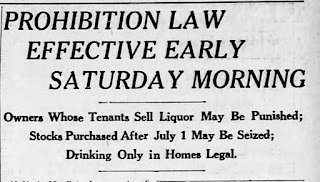
In 1917, the 18th Amendment was passed in Congress and it was ratified in 1919. At 12:01 A.M. on January 17, 1920 Prohibition went into effect.


"PROHIBITION LAW EFFECTIVE EARLY SATURDAY MORNING: Owners Whose Tenants Sell Liquor May Be Punished; Stocks Purchased Ater July 1 May Be Seized; Drinking Only in Homes Legal.


Dixon, Illinois16 Jan 1920, Fri • Page 1

"Spectacular robberies marked the early hours of prohibition eve here.  In one six masked men bound the yardmaster and watchman of the Pennsylvania Railroad, drove six trainmen into a shanty, and took between $5-,--- and $100,000 worth of whiskey from the two box cars.
In the other several men held a watchman for the Coco Cola company at bay with revolvers and rolled four barrels of alcohol from a warehouse to a waiting truck.  Their booty was valued at $5000."


Explores the extraordinary story of what happens when a freedom-loving nation outlaws the sale of intoxicating liquor and the disastrous unintended consequences that follow. Raises profound questions about the proper role of government and the limits of legislating morality.


Last Call: The Rise and Fall of Prohibition by Okrent, Daniel

Okrent explores the origins, implementation, and failure of that great American delusion known as Prohibition. "Last Call" explains how Prohibition happened, what life under it was like, and what it did to the country.


Al Capone's Beer Wars: A Complete History of Organized Crime in Chicago During Prohibition by Binder, John J.

"Based on 25 years of research using all available sources, this is the definitive history of organized crime in Chicago through the end of the Prohibition Era"-- Provided by publisher.


"The epic true crime story of bootlegger George Remus and the murder that shocked the nation, from the New York Times bestselling author of Sin in the Second City and Liar, Temptress, Soldier, Spy In the early days of Prohibition, long before Al Capone became a household name, a German immigrant named George Remus quits practicing law and starts trafficking whiskey. Within two years he's a multi-millionaire. The press calls him "King of the Bootleggers," writing breathless stories about the Gatsby-esque events he and his glamorous second wife, Imogene, host at their Cincinnati mansion, with party favors ranging from diamond jewelry for the men to brand-new Pontiacs for the women. By the summer of 1921, Remus owns 35 percent of all the liquor in the United States. Pioneering prosecutor Mabel Walker Willebrandt is determined to bring him down. Willebrandt's bosses at the U.S. Attorney's office hired her right out of law school, assuming she'd pose no real threat to the cozy relationship they maintain with Remus. Eager to prove them wrong, she dispatches her best investigator, Franklin Dodge, to look into his empire. It's a decision with deadly consequences: with Remus behind bars, Franklin and Imogene begin an affair and plot to ruin him, sparking a bitter feud that soon reaches the highest levels of government--and that can only end in murder. Combining deep historical research with novelistic flair, The ghosts of Eden Park is the unforgettable, stranger-than-fiction story of a rags-to-riches entrepreneur and a long-forgotten heroine, of the excesses and absurdities of the Jazz Age, and of the infinite human capacity to deceive"-- Provided by publisher.

 
 Provides a tour through the feminist history of women drinking, revealing the untold female distillers, drinkers, and brewers that played vital roles in potent potable history, from ancient Sumerian beer goddess Ninkasi to 1920s bartender Ada Coleman.


"June 1925. Audacious Appalachian flapper Geneva "Gin" Kelly prepares to trade her high-flying ways for a respectable marriage to Oliver Anson Marshall, a steadfast Prohibition agent who happens to hail from one of New York's most distinguished families. But just as wedding bells chime, the head of the notorious East Coast rum-running racket -- and Anson's mortal enemy -- turns up murdered at a society funeral, and their short-lived honeymoon bliss goes up in a spectacular blaze that sends Anson back undercover ... and into the jaws of a trap from which not even Gin can rescue him. As violence explodes around her, Gin must summon all her considerable moxie to trace the tentacles of this sinister organization back to their shocking source, and face down a legendary American family at a rigged game it has no intention of losing. June 1998. When Ella Dommerich's ninety-something society queen aunt Julie ropes her into digging up dirt on Senator (and Presidential candidate) Franklin Hardcastle in order to settle old family scores, she couldn't be less enthusiastic. Pregnant Ella's recently ditched her unfaithful husband and settled into cozy -- if complicated -- domesticity with her almost-too-good-to-be-true musician boyfriend, Hector. But then the Hardcastle secrets lead to a web of shady dealings Ella's uncovered in her job as a financial analyst, and the bodies start to tumble out of the venerable woodwork. With the help of her ex-husband and her mysterious connection to a certain redheaded flapper, Ella digs up more than mere dirt -- only to discover herself standing alone between a legendarily ruthless family and the prize it's sought for generations. What ugly secrets lurk in the opulent enclaves -- and bank accounts -- of America's richest families? And can two determined women from two different generations thwart the murderous legacy of the demon liquor?" --. Provided by publisher.


Ohio, 1927: Moonshining is a way of life in rural Bronwyn County, and even the otherwise upstanding Sheriff Lily Ross has been known to turn a blind eye when it comes to stills in the area. But when thirteen-year-old Zebediah Harkins almost dies after drinking tainted moonshine, Lily knows that someone has gone too far, and--with the help of organizer and moonshiner Marvena Whitcomb--is determined to find out who.


"Thatcher Hutton, a war-weary soldier on the way back to his cowboy life, jumps from a moving freight train to avoid trouble . . . and lands in more than he bargained for"--. Provided by publisher.


Monday, October 25, 2021

Tombstone


30 seconds is all it took for a gunfight to transcend into a legend. On October 26, 1881, Virgil Earp, Tombstones Town Marshall, decided to confront cowboys Frank McLaury, Tom McLaury, Billy Clanton, Billy Claiborne, Wes Fuller, and Ike Clanton, who had been flouting the local gun ordinance. Virgil's brothers, Wyatt and Morgan, and their friend Doc Holliday acted as backup. As Virgil approached he announced his presence and his intent to disarm the cowboys. The cowboys responded by drawing and cocking their guns. From there the story varies, according to witness accounts. What we do know, is that Wyatt Earp was the one left standing, completely unharmed.
  

 https://crimereads.com/how-wyatt-earp-went-from-lawman-to-legend/

 
"The true story of the Earp brothers, Doc Holliday, and the famous Battle at the OK Corral, by the New York Times bestselling author of Dodge City and Wild Bill. On the afternoon of October 26, 1881, nine men clashed in what would be known as the most famous shootout in American frontier history. Thirty bullets were exchanged in thirty seconds, killing three men and wounding three others. The fight sprang forth from a tense, hot summer. Cattle rustlers had been terrorizing the backcountry of Mexico and selling the livestock they stole to corrupt ranchers. The Mexican government built forts along the border to try to thwart American outlaws, while Arizona citizens became increasingly agitated. Rustlers, who became known as the cowboys, began to kill each other as well as innocent citizens. That October, tensions boiled over with Ike and Billy Clanton, Tom and Frank McLaury, and Billy Claiborne confronting the Tombstone marshal, Virgil Earp, and the suddenly deputized Wyatt and Morgan Earp and shotgun-toting Doc Holliday. Bestselling author Tom Clavin peers behind decades of legend surrounding the story of Tombstone to reveal the true story of the drama and violence that made it famous. Tombstone also digs deep into the vendetta ride that followed the tragic gunfight, when Wyatt and Warren Earp and Holliday went vigilante to track down the likes of Johnny Ringo, Curly Bill Brocius, and other cowboys who had cowardly gunned down his brothers. That "vendetta ride" would make the myth of Wyatt Earp complete and punctuate the struggle for power in the American frontier's last boom town"-- Provided by publisher.


  A complete history of the life of Wyatt Earp, which is derived from the accounts of his contemporaries, and includes a consideration of the Hollywood legend which grew around the stories of his exploits.


Chronicles the career of Doc Holliday in an attempt to learn the truth about the Southern dentist-turned Western adventurer whose association with Wyatt Earp and other escapades in the frontier has inspired books, songs, and legends.


 Dodge City: Wyatt Earp, Bat Masterson, and the Wickedest Town in the American West by Clavin, Thomas

 "Dodge City, Kansas, is a place of legend. The town that started as a small military site exploded with the coming of the railroad, cattle drives, eager miners, settlers, and various entrepreneurs passing through to populate the expanding West. Before long, Dodge City's streets were lined with saloons and brothels and its populace was thick with gunmen, horse thieves, and desperadoes of every sort. By the 1870s, Dodge City was known as the most violent and turbulent town in the West. Enter Wyatt Earp and Bat Masterson. Young and largely self-trained men, the lawmen led the effort that established frontier justice and the rule of law in the American West, and did it in the wickedest place in the United States. When they moved on, Wyatt to Tombstone and Bat to Colorado, a tamed Dodge was left in the hands of Jim Masterson. But before long Wyatt and Bat, each having had a lawman brother killed, returned to that threatened western Kansas town to team up to restore order again in what became known as the Dodge City War before riding off into the sunset. The true story of their friendship, romances, gunfights, and adventures, along with the remarkable cast of characters they encountered along the way (including Wild Bill Hickock, Jesse James, Doc Holliday, Buffalo Bill Cody, John Wesley Hardin, Billy the Kid, and Theodore Roosevelt) has gone largely untold--lost in the haze of Hollywood films and western fiction, until now"-- Provided by publisher.


A revisionist history of the Old West battle challenges popular depictions of such figures as the Earps and Doc Holliday, tracing the influence of a love triangle, renegade Apaches, and the citizens of Tombstone.


For nearly fifty years, she was the common-law wife of Wyatt Earp: hero of the O.K. Corral and the most famous lawman of the Old West. Yet Josephine Sarah Marcus Earp has nearly been erased from Western lore. In this fascinating biography, Ann Kirschner, author of the acclaimed Sala's Gift, brings Josephine out of the shadows of history to tell her tale: a spirited and colorful tale of ambition, adventure, self-invention, and devotion. Reflective of America itself, her story brings us from the post-Civil War years to World War II, and from New York to the Arizona Territory to old Hollywood.


"It is 1862. With his older brothers fighting in the war, Wyatt Earp - at fourteen - is left to manage the family's Iowa farm under his father's iron rule. These years of labor inculcate into him an ambition to seek his fortunes by his wits rather than the sweat of his back. The open territory to the west, he knows, offers that opportunity. When his family treks to California he makes the passing acquaintance of a beguiling Mexican girl, whose philosophy of success and failure will haunt Wyatt for years to come. It is the prophecy of the "adobe moon," a rusty-hued orb that reminds a man: If you do not achieve your dreams, you must settle for what you have. Though rejecting this creed, Wyatt feels the notion dog him like a ghost. After stints as coach driver, freight-hauler, and grader for the railroad, Wyatt takes his first "respectable" job as constable in a small Missouri town. There he meets the woman who teaches him the value of settling down with family. When she dies with child, Wyatt sinks into a depression where the lines of ethics blur. Wanted by the law he loses himself in the waterfront slums of Peoria working in brothels. Fed up with his self-made squalor, he returns to the West for a second chance at a proper life. In a Kansas cattle town he comes face to face with his salvation . . . and his destiny as a lawman with his own iron rule" -- Provided by publisher.


 The year is 1878, peak of the Texas cattle trade. The place is Dodge City, Kansas, a saloon-filled cow town jammed with liquored-up adolescent cowboys and young Irish hookers. Violence is random and routine, but when the burned body of a mixed-blood boy named Johnnie Sanders is discovered, his death shocks a part-time policeman named Wyatt Earp. And it is a matter of strangely personal importance to Doc Holliday, the frail twenty-six-year-old dentist who has just opened an office at No. 24, Dodge House.


 A sequel to Doc is based on the true events of the gunfight at the O.K. Corral and Wyatt Earp's survival against a backdrop of volatile politics in 1881 America
 
 
 A sequel to Doc is based on the true events of the gunfight at the O.K. Corral and Wyatt Earp's survival against a backdrop of volatile politics in 1881 America.


You Know My Name

November 2026

November is a month full of celebrations; not just Veterans Day and Thanksgiving. It is Native American Heritage Month and Men's Health ...