Translate

Showing posts with label Women's History. Show all posts

Thursday, May 25, 2023

Fashion History


The anniversary of when women were finally able to legally wear pants in the US may not seem like a big deal for some, but, having worn skirts outside during an Illinois Winter, pants have my utmost respect. I love pants, comfy ones, soft ones, and ones with pockets, real pockets like they give to men, where your whole hand, a wallet, a small animal, and snacks will fit inside.

The US Attorney General declared it legal for women to wear trousers anywhere on May 28th, 1923; just 100 years ago. That's not to say it was a free-for-all on pants-wearing after that. It wasn't until 1972, when the Title IX non-discrimination provisions, of the 1972 Education Amendments declared that dresses could not be required of girls in public schools. (Trousers as women's clothing) However, in France, the freedom to wear trousers wasn't given to women until 2013; not that the matter had been strictly enforced, but the ban on trousers existed all the same, and in 2019, female flight attendants on Virgin Atlantic were finally allowed to wear trousers. ( A brief history of women wearing trousers).


On Dec. 24, 1969, Washington Post reported a story that "hailed Rep. Charlotte T. Reid (R-Ill.) for showing up on the last day before recess 'in a black wool, bell-bottomed pantsuit. . . a first in the annals of the U.S. Congress.'...Many male colleagues ran to the floor to gawk, she told The Post, but all were kind. 'Gerald Ford [then the minority leader] told me he thought it was great, and I should do it more often.'" https://www.washingtonpost.com/blogs/reliable-source/post/update-first-woman-to-wear-pants-on-house-floor-rep-charlotte-reid/2011/12/21/gIQAVLD99O_blog.html

Also in 2019, Norwin High School in North Huntingdon, Pennsylvania was taken to task when then senior Hannah Kozak, objected to the school's graduation dress code. The school sent out letters, stating that any female student choosing to wear pants at graduation would receive their diploma a week after graduation and not at the ceremony. After speaking out at school board meeting, Hannah Koziak, convinced the principal and the board of the need to modify the dresscode. The changed the terms to "professional attire". https://www.insider.com/norwin-high-school-senior-challenged-graduation-dress-code-to-wear-pants-2019-5

And in June of 2022, a federal appeals court ruled that a Charter School in. North Carolina was in violation of federal Title IX anti-discrimination law. (Federal court: NC school can’t require girls to wear skirts).

Clothing or fashion, has a long history. There are different tastes, styles, dress codes, and judgments made when it comes to what we wear. Fashion can be celebrated and it can be weaponized.


Every generation can recall and identify with the fashion icons and idols of their era. The crinoline-caged Victorian female, the Gibson girl, and the grunge-layered youth of the 1990s all reflect the influences and extremes of their life and times. The start of the 19th century marks the dawn of the designer, a sartorial influence that became a star-studded industry. Fashion: A Visual History charts those points in time when distinctive styles that began as extravagances of the very rich permeated through well-dressed society until a cut of cloth or choice of accessory defined fashion. This elegantly- dressed volume assesses the contribution of such innovative players as Worth, Chanel, Dior, Saint Laurent, Klein, Westwood, and Gaultier, as well as the effects of stage, screen, music, dance, and sports celebrities on our ever-changing sense of fashion. Each spread focuses on a definitive item--be it a bowler hat or little black dress, stiletto, or caftan--or identifies key shifts in fashion that reflect excess, liberation, austerity, nostalgia, and technology, displaying it in contemporary images ranging from paintings and illustrated fashion plates to cartoons and photographs. Evocative primary quotes complete a history that visually traces the revealing evolution of fashion in Western society. --front cover


"From simple to sophisticated, elegant to excessive, what we wear says who we are. "Fashion" is the ultimate visual guide to everything ever worn. From the extravagance of Ancient Egypt, through the legendary fashion houses of Chanel and Dior, to the latest cutting-edge labels, this gorgeous collection of costume and dress shows how fashion reflects people and places, and captures the times in which they lived."--p.[4] of cover.


"Style is not just the clothes on our backs--it is self-expression, representation, and transformation. As a fashion-obsessed Ojibwe teen, Christian Allaire rarely saw anyone that looked like him in the magazines or movies he looked to for inspiration. Now the Fashion and Style Writer for Vogue, he is working to change that--because clothes are never just clothes. Men's heels are a statement of pride in the face of LGTBQ+ discrimination, while ribbon shirts honor Indigenous ancestors and keep culture alive. Allaire takes the reader through boldly designed chapters to discuss additional topics like cosplay, make up, hijabs, and hair, probing the connections between fashion and history, culture, politics, and social justice."--. Provided by publisher.


"Equal parts fab and frightening, Killer Style explores the ways in which make-up, clothing, and accessories have killed, maimed, or tormented those who wear and make them. From the story of hatters felled by mercury poisoning to tulle-burnt ballerinas to the victims of the modern craze for sandblasted denim, no one is safe from these crimes of fashion."-- Provided by publisher.


"Explores the lives of ten famous women who have used clothing to make a statement, change perceptions, break rules, attract power, or express their individuality. Included are Cleopatra, Marie Antoinette, Coco Chanel, Marlene Dietrich, Madonna, and Lady Gaga. Sidebar subjects include: Elizabeth I, Marilyn Monroe, Rihanna, and Vivienne Westwood."--Provided by publisher.


"Covering everyone from Louis XIV to Prince, Bad Boys of Fashion looks at men across history who have broken the rules both in fashion and in life."-- Provided by publisher.


Fashion is ever-changing, and while some styles mark a dramatic departure from the past, many exhibit subtle differences from year to year that are not always easily identifiable. With overviews of each key period and detailed illustrations for each new style, How to Read a Dress is an authoritative visual guide to women's fashion across five centuries.

Each entry includes annotated color images of historical garments, outlining important features and highlighting how styles have developed over time, whether in shape, fabric choice, trimming, or undergarments. Readers will learn how garments were constructed and where their inspiration stemmed from at key points in history - as well as how dresses have varied in type, cut, detailing and popularity according to the occasion and the class, age and social status of the wearer.

This lavishly illustrated book is the ideal tool for anyone who has ever wanted to know their cartridge pleats from their Récamier ruffles. Equipping the reader with all the information they need to 'read' a dress, this is the ultimate guide for students, researchers, and anyone interested in historical fashion. --Provided by Publisher


"A look at fast fashion and its impact on the environment and social justice, based on the adult nonfiction title Fashionopolis and adapted for young readers"--. Provided by publisher.


"Discover how the Lane Bryant clothing brand changed the way we buy clothes forever by celebrating bodies of all shapes and sizes in this inclusive picture book biography of a Lithuanian immigrant with a brilliant eye for fashion and business"--. Provided by publisher.




Thursday, March 2, 2023

Women's Her-story Month


Women have a long history of being absent in history.

Instead of finding inclusion in history classes, women, along with other minorities, are set aside for month-long celebrations or class electives.  

This year Women's History Month seeks to celebrate the storytellers; the women, past and present, who investigate, who report, and who share.

These are the women, whose work keeps other women, past and present, from being erased.

https://femlens.com/blog-post/the-root-of-female-erasure-from-storytelling/

https://www.stylist.co.uk/people/matilda-effect-what-is-it-erasure-achievements-by-women-susan-sontag-hidden-women/267412


"Male literary friendships are the stuff of legend, from Byron and Shelley to Fitzgerald and Hemingway. But the world's most celebrated female authors are usually mythologized as solitary eccentrics or isolated geniuses. Friends Emily Midorikawa and Emma Claire Sweeney prove this wrong, thanks to their investigations into a wealth of surprising collaborations: the friendship between Jane Austen and one of the family servants, amateur playwright Anne Sharp; the daring feminist author Mary Taylor, who shaped the work of Charlotte Brontë; the transatlantic friendship of the seemingly aloof George Eliot and the ebullient Harriet Beecher Stowe; and Virginia Woolf and Katherine Mansfield, most often portrayed as bitter foes, but who, in fact, enjoyed a complex friendship fired by an underlying erotic charge. Drawing on letters and diaries, some of which have never been published before, A Secret Sisterhood resurrects these stories of female friendships and literary collaborations. They were sometimes scandalous and volatile, sometimes supportive and inspiring, but always--until now--tantalizingly consigned to the shadows."--Jacket flap.


"A family memoir that traces the myths, legends, and secrets of seven generations of remarkable women. All families have their myths and legends. For many years Juliet Nicolson accepted hers--the dangerous beauty of her flamenco dancing great-great-grandmother Pepita, the flirty manipulation of her great-grandmother Victoria, the infamous eccentricity of her grandmother Vita Sackville-West, her mother's Tory-conventional background. But then Juliet, a distinguished historian, started to question. As she did so, she sifted fact from fiction, uncovering details and secrets long held just out of sight. A House Full of Daughters takes us through seven generations of women. In the nineteenth-century slums of Malaga, the salons of fin-de-siecle Washington D.C., an English boarding school during the Second World War, Chelsea in the 1960s, the knife-edge that was New York City in the 1980s, these women emerge for Juliet as people in their own right, but also as part of who she is and where she has come from. A House Full of Daughters is one woman's investigation into the nature of family, memory, and the past. As Juliet finds uncomfortable patterns reflected in these distant and more recent versions of herself, she realizes her challenge is to embrace the good and reject the hazards that have trapped past generations"-- Provided by publisher.


Born in 1864, Nellie Bly was a woman who did not allow herself to be defined by the time she lived in, she rewrote the narrative and made her own way.

Luciana Cimino's meticulously researched graphic-novel biography tells Bly's story through Miriam, a fictionalized female student at the Columbia School of Journalism in 1921. While interviewing the famous journalist, Miriam learns not only about Bly's more sensational adventures, but also about her focus on self-reliance from an early age, the scathing letter to the editor that jump-started her career as a newspaper columnist, and her dedication to the empowerment of women. In fact, in 1884, Bly was one of the few journalists who interviewed Belva Ann Lockwood, who was the first woman candidate for a presidential election-a contest that was ultimately won by Grover Cleveland-and Bly predicted correctly that women would not get the vote until 1920.

Of course Bly's most well-known exploits are also covered-how she pretended to be mad in order to get institutionalized so she could carry out an undercover investigation in an insane asylum, and Bly's greatest feat of all, her journey around the world in 72 days-alone-which was unthinkable for a woman in the late 19th century. As Miriam learns more of Bly's story, she realizes that the most important stories are necessarily the ones with the most dramatic headlines, but the ones that, in Nellie's words, "come from a deep feeling."

This beautifully executed graphic novel paints a portrait of a woman who defied societal expectations-not only with her investigative journalism, but with her keen mind for industry, and her original inventions.


"Before the Brontë sisters picked up their pens, or Jane Austen's heroines Elizabeth and Jane Bennet became household names, the literary world was celebrating a different pair of sisters: Jane and Anna Maria Porter. The Porters-exact contemporaries of Jane Austen-were brilliant, attractive, self-made single women of polite reputation who between them published twenty-six books and achieved global fame. They socialized among the rich and famous, tried to hide their family's considerable debt, and fell dramatically in and out of love. Their moving letters to each other confess every detail. Because the celebrity sisters expected their renown to live on, they preserved their papers, and the secrets they contained, for any biographers to come. But history hasn't been kind to the Porters. Credit for their literary invention was given to their childhood friend, Sir Walter Scott, who never publicly acknowledged his debt to their ideas. With Scott's more prolific publication and even greater renown, the Porter sisters gradually fell from the pinnacle of celebrity to eventual obscurity. Now, Professor Devoney Looser, a Guggenheim fellow in English Literature, sets out to re-introduce the world to the authors who cleared the way for Austen, Mary Shelley, and the Brontë sisters. Capturing the Porter sisters' incredible rise, from when Anna Maria published her first book at age fourteen in 1793, through to Jane's fall from prominence in the Victorian era, and then to the auctioning off for a pittance of the family's massive archive, Sister Novelists is a groundbreaking and enthralling biography of two pioneering geniuses in historical fiction"--Book jacket flap.


In the years after the Civil Rights Act of 1964, women in the workplace still found themselves relegated to secretarial positions or locked out of jobs entirely. This was especially true in the news business, a backwater of male chauvinism where a woman might be lucky to get a foothold on the "women's pages." But when a pioneering nonprofit called National Public Radio came along in the 1970s, and the door to serious journalism opened a crack, four remarkable women came along and blew it off the hinges. 0Susan, Linda, Nina, and Cokie is journalist Lisa Napoli's captivating account of these four women, their deep and enduring friendships, and the trail they blazed to becoming icons. They had radically different stories. Cokie Roberts was born into a political dynasty, roamed the halls of Congress as a child, and felt a tug toward public service. Susan Stamberg, who had lived in India with her husband who worked for the State Department, was the first woman to anchor a nightly news program and pressed for accommodations to balance work and home life. Linda Wertheimer, the daughter of shopkeepers in New Mexico, fought her way to a scholarship and a spot on-air. And Nina Totenberg, the network's legal affairs correspondent, invented a new way to cover the Supreme Court. Based on extensive interviews and calling on the author's deep connections in news and public radio, Susan, Linda, Nina, and Cokie will be as beguiling and sharp as its formidable subjects.


This collection of twenty-one essays from major YA authors--including award-winning and bestselling writers--touches on a powerful range of topics related to growing up female in today's America, and the intersection with race, religion, and ethnicity. Sure to inspire hope and solidarity to anyone who reads it, Our Stories, Our Voices belongs on every young woman's shelf.

This anthology features essays from Martha Brockenbrough, Jaye Robin Brown, Sona Charaipotra, Brandy Colbert, Somaiya Daud, Christine Day, Alexandra Duncan, Ilene Wong (I.W.) Gregorio, Maurene Goo. Ellen Hopkins, Stephanie Kuehnert, Nina LaCour, Anna-Marie LcLemore, Sandhya Menon, Hannah Moskowitz, Julie Murphy, Aisha Saeed, Jenny Torres Sanchez, Amber Smith, and Tracy Walker.


Presents a social history of women journalists of the Gilded Age who went undercover to champion women's rights and expose corruption and abuse in America.
In the waning years of the nineteenth-century women journalists across the United States risked reputation and their own safety to expose the hazardous conditions under which many Americans lived and worked. They stole into sewing factories to report on child labor, fainted in the streets to test public hospital treatment, posed as lobbyists to reveal corrupt politicians. Todd shows how these "girl stunt reporters" changed laws, helped launch a labor movement, championed women's rights, and redefined journalism for the modern age. -- adapted from jacket


Dorothy Butler Gilliam, whose 50-year-career as a journalist put her in the forefront of the fight for social justice, offers a comprehensive view of racial relations and the media in the U.S.

Most civil rights victories are achieved behind the scenes, and this riveting, beautifully written memoir by a "black first" looks back with searing insight on the decades of struggle, friendship, courage, humor and savvy that secured what seems commonplace today-people of color working in mainstream media.

Told with a pioneering newspaper writer's charm and skill, Gilliam's full, fascinating life weaves her personal and professional experiences and media history into an engrossing tapestry. When we read about the death of her father and other formative events of her life, we glimpse the crippling impact of the segregated South before the civil rights movement when slavery's legacy still felt astonishingly close. We root for her as a wife, mother, and ambitious professional as she seizes once-in-a-lifetime opportunities never meant for a "dark-skinned woman" and builds a distinguished career. We gain a comprehensive view of how the media, especially newspapers, affected the movement for equal rights in this country. And in this humble, moving memoir, we see how an innovative and respected journalist and working mother helped provide opportunities for others.

With the distinct voice of one who has worked for and witnessed immense progress and overcome heart-wrenching setbacks, this book covers a wide swath of media history -- from the era of game-changing Negro newspapers like the Chicago Defender to the civil rights movement, feminism, and our current imperfect diversity. This timely memoir, which reflects the tradition of boot-strapping African American storytelling from the South, is a smart, contemporary consideration of the media.


Ida B. The Queen: The Extraordinary Life and Legacy of Ida B. Wells by Duster, Michelle

Written by her great-granddaughter, a historical portrait of the boundary-breaking civil rights pioneer covers Wells' early years as a slave, her famous acts of resistance, and her achievements as a journalist and anti-lynching activist.


"Reporter for the New York Times; ... foreign correspondent in some of the most dangerous fields; Pulitzer winner; [and] longest jailed correspondent for protecting her sources, Judith Miller ... turns her reporting skills on herself with the intensity of her professional vocation"--Amazon.com.
As a foreign and investigative reporter, Miller is highly respected and controversial. In this memoir she turns her reporting skills on herself, writing about the mistakes she and others made on the existence in Iraq of weapons of mass destruction; addressing the motives of some of her sources; describing going to jail to protect her sources in the Scooter Libby investigation of the outing of CIA agent Valerie Plame and how the Times subsequently abandoned her. Miller's career is an adventure story, told with bluntness and wryness.


The Double Life of Katharine Clark: The Untold Story of the American Journalist Who Risked her Life for Truth and Justice by Gregorio, Katharine

"Illuminating a thrilling untold chapter of the Cold War, The Double Life of Katharine Clark shares the forgotten story of a remarkable woman who pioneered a career in a male-dominated profession. In 1955, Katharine Clark became the first female American wire reporter behind the Iron Curtain, forging a career as a journalist, befriending a leading Communist, and risking her life to smuggle away books that exposed the truth about Communism to the world. This dramatic historical narrative shows how one woman with an unwavering commitment to truth, justice, and freedom of the press put her life on the line to reshape American history"--. Provided by publisher.


https://nationalwomenshistoryalliance.org/


.                 .                  


.                                  


Wednesday, March 16, 2022

World Storytelling Day


The theme of World Storytelling Day 2022 is “Lost and Found”. It was inspired by all that we lost in the past years and the hope of stories inspiring us to find it back again. Storytellers all over the world will tell stories on March 20 2022 on this theme.   https://internationalstoryteller.com/world-storytelling-day/

Nothing seems to get lost quite like the stories of women and their many contributions throughout history.  Luckily within these books, some of those stories have been found again.  For example, in 2009, someone finally asked where female artists of the Renaissance were, a search began, and as of January of 2021, 2000 works of art have been recovered, 70 of them have been restored, and the stories of their creators are starting to come to light.  ('Where Are The Women?': Uncovering The Lost Works Of Female Renaissance Artists by SYLVIA POGGIOLI).


"Looking through the ages and across the globe, [the authors] have reclaimed the stories of twenty-five remarkable women who dared to defy history and change the world around them. From Mongolian wrestlers to Chinese pirates, Native American ballerinas to Egyptian scientists, Japanese novelists to British Prime Ministers, [this book] will reframe the history that you thought you knew"--Provided by publisher.


"Providing a new and illuminating look at 27 women who've changed the world, Dead Feminists ties these historical women and the challenges they faced into the most important issues of today. Based on the cult-following limited edition Dead Feminists letterpress poster series by illustrator Chandler O'Leary and letterpress artist Jessica Spring, the book combines new art and lettering, archival photographs and ephemera, and revisits the original poster to tell each woman's story. Each chapter is a call to action (Protect, Make, Grow, Teach, Lead, Tell, Share, Play), and shows how the women exemplified that quality in their own ways. This book takes feminist inspiration to a new level of artistry and shows how ordinary and extraordinary women have made a difference throughout history (and how you can too!)"-- Provided by publisher.


Based on Mackenzi Lee's popular weekly Twitter series of the same name, Bygone Badass Broads features 52 remarkable and forgotten trailblazing women from all over the world. With tales of heroism and cunning, in-depth bios, and witty storytelling, Bygone Badass Broads gives new life to these historic female pioneers. Starting in the fifth century BC and continuing to the present, the book takes a closer look at bold and inspiring women who dared to step outside the traditional gender roles of their time. Coupled with riveting illustrations and Lee's humorous and conversational storytelling style, this book is an outright celebration of the badass women who paved the way for the rest of us.


"She was black and a woman and a prosecutor, a graduate of Smith College and the granddaughter of slaves, as dazzlingly unlikely a combination as one could imagine in the New York of the 1930s--and without the strategy she devised, Lucky Luciano, the most powerful Mafia boss in history, would never have been convicted. When special prosecutor Thomas E. Dewey selected twenty lawyers to help him clean up the city's underworld, she was the only member of his team who was not a white male. Eunice Hunton Carter, Stephen Carter's grandmother, was raised in a world of stultifying expectations about race and gender, yet by the 1940s her professional and political successes had made her one of the most famous black women in America. But her triumphs were shadowed by prejudice and tragedy. Greatly complicating her rise was her difficult relationship with her younger brother, Alphaeus, an avowed Communist who--together with his friend Dashiell Hammett--would go to prison during the McCarthy era. Yet she remained unbowed. Moving, haunting, and as fast-paced as a novel, [this book] tells the true story of a woman who often found her path blocked by the social and political expectations of her time. But Eunice Carter never accepted defeat, and thanks to her grandson's remarkable book, her long-forgotten story is once again visible."--Dust jacket.


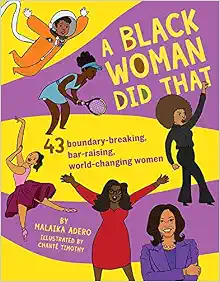
"A Black Woman Did That is a celebration of strong, resilient, innovative, and inspiring women of color. With a vibrant mixture of photography, illustration, biography, and storytelling, author Malaika Adero will spotlight well-known historical figures and women who are pushing boundaries today--including Ida B. Wells, Madam CJ Walker, Shirley Chisholm, Serena Williams, Mae Jamison, Stacey Abrams, Jesmyn Ward, Ava DuVernay, and Amy Sherald."--publisher's description.


"One of the most influential disability rights activists in US history tells her story of fighting to belong in school and society -a powerful role model for young adults with a passion for activism"--. Provided by publisher.


"Biography of Elizebeth Smith Friedman, an American woman who pioneered codebreaking in WWI and WWII but was only recently recognized for her extraordinary contributions to the field"--. Provided by publisher.


Fannie Sellins (1872-1919) lived during the Gilded Age of American Industrialization when the Carnegies and Morgans wore jewels while their laborers wore rags. Fannie dreamed that America could achieve its ideals of equality and justice for all, and she sacrificed her life to help that dream come true. Fannie became a union activist, helping to create St. Louis, Missouri, Local 67 of the United Garment Workers of America. She traveled the nation and eventually gave her life, calling for fair wages and decent working and living conditions for workers in both the garment and mining industries. Her accomplishments live on today. This book includes an index, glossary, a timeline of unions in the United States, and endnotes.


With her characteristic wit and dazzling drawings, celebrated graphic novelist Penelope Bagieu profiles the lives of these feisty female role models, some world-famous, some little known. From Nellie Bly to Mae Jemison or Josephine Baker to Naziq al-Abid, the stories in this comic biography are sure to inspire the next generation of rebel ladies.


"Interviews with astonishing women from history! How did Elizabeth I smash the Spanish Armada? How did Anne Frank's diary help her deal with despair? Was Ching Shih the world's coolest pirate queen? Uncover all this and more in Corpse Talk, the hilarious and mind-expanding chat show that brings famous corpses back to life!"-- cover page 4.


"An historical and imaginative tour-de-force, WAKE brings to light for the first time the existence of enslaved black women warriors, whose stories can be traced by carefully scrutinizing historical records; and where the historical record goes silent, WAKE reconstructs the likely past of two female rebels, Adono and Alele, on the slave ship The Unity. WAKE is a graphic novel that offers invaluable insight into the struggle to survive whole as a black woman in today's America; it is a historiography that illuminates both the challenges and the necessity of uncovering the true stories of slavery; and it is an overdue reckoning with slavery in New York City where two of these armed revolts took place. It is, also, a transformative and transporting work of imaginative fiction, bringing to three-dimensional life Adono and Alele and their pasts as women warriors. In so doing, WAKE illustrates the humanity of the enslaved, the reality of their lived experiences, and the complexity of the history that has been, till now, so thoroughly erased"--. Provided by publisher


"America's modern culinary history told through the lives of seven pathbreaking chefs and food writers. Who's really behind America's appetite for foods from around the globe? This group biography from an electric new voice in food writing honors seven extraordinary women, all immigrants, who left an indelible mark on the way Americans eat today. Taste Makers stretches from World War II to the present, with absorbing and deeply researched portraits of figures including Mexican-born Elena Zelayeta, a blind chef; Marcella Hazan, the deity of Italian cuisine; and Norma Shirley, a champion of Jamaican dishes. In imaginative, lively prose, Mayukh Sen-a queer, brown child of immigrants-reconstructs the lives of these women in vivid and empathetic detail, daring to ask why some were famous in their own time, but not in ours, and why others shine brightly even today. Weaving together histories of food, immigration, and gender, Taste Makers will challenge the way readers look at what's on their plate-and the women whose labor, overlooked for so long, makes those meals possible"--. Provided by publisher.


Raised on a cattle ranch, Agnes Morley was sent to Stanford University to learn to be a lady. Yet in no time she exchanged her breeches and spurs for bloomers and a basketball; and in April 1896 she made history. In a heart-pounding game against the University of California at Berkeley, Agnes led her team to victory in the first-ever intercollegiate women's basketball game, earning national attention and putting women's basketball on the map.


 Check out more from our catalog here:  


"The most common characteristic of women's history is to be lost and discovered, lost again and rediscovered, lost once more and re-rediscovered - a process of tragic waste and terrible silences that will continue until women's stories are a full and equal part of the human story."


November 2026

November is a month full of celebrations; not just Veterans Day and Thanksgiving. It is Native American Heritage Month and Men's Health ...